
How to Make Water Safe to Drink in an Emergency
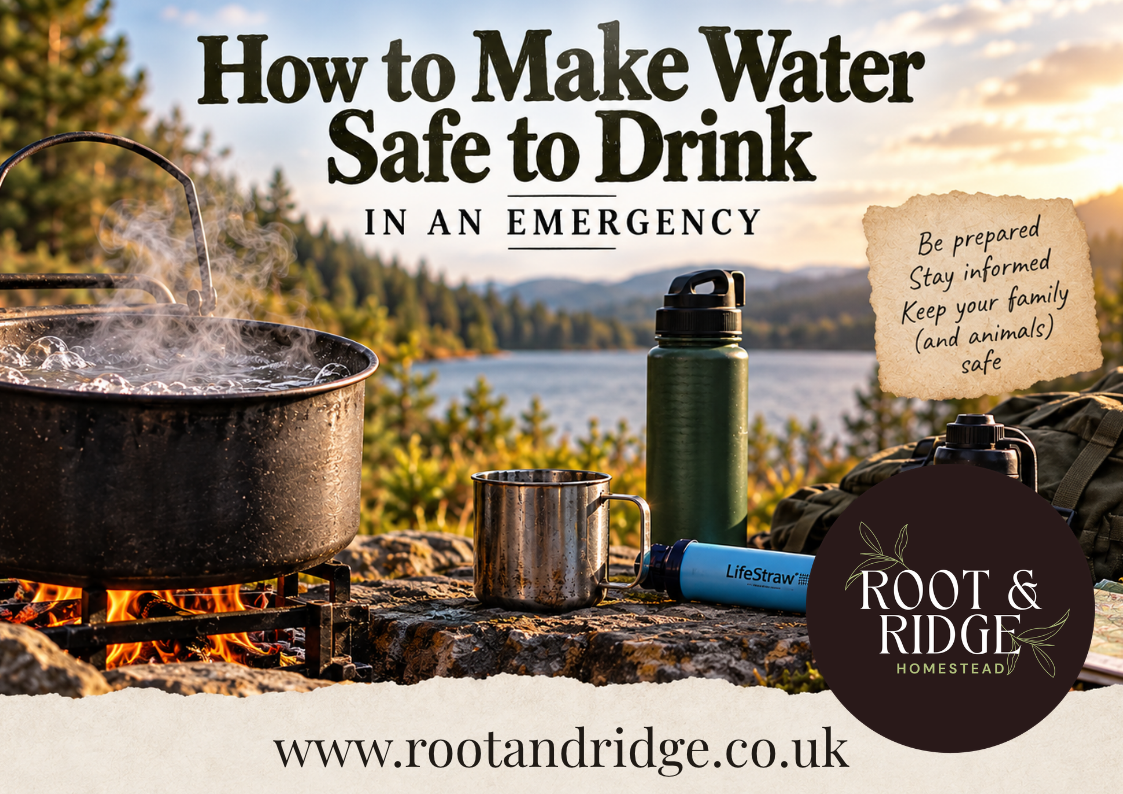
Water is probably one of the most important things we need to think about when we’re talking about emergency preparedness, because although most of us have some bottled water put away, that only solves the problem for as long as that water lasts. What happens if the water coming out of the tap suddenly isn’t safe to drink? What happens if the water goes off completely for several days, or you have to collect rainwater or water from another source? And, perhaps more importantly, do you know how to make that water safe once you’ve got it? There are quite a few ways of treating water, from simply boiling it to filters, purification straws, tablets and UV treatment, but they don’t all do the same thing, and this is where I think it’s really easy to get caught out. Water looking clean absolutely does not mean that it’s safe to drink, and something being sold as a “water filter” doesn’t necessarily mean it’s going to remove everything that can make you ill either.
Before we get into the different ways of treating water, there is one important rule that applies to everything in this article. If your water company, local authority or another relevant authority has issued instructions about your water supply, follow the advice given for that particular incident. A boil-water notice and a do-not-drink notice are very different things, and boiling is not the answer to every form of contamination. The methods we’re looking at here are useful emergency-preparedness knowledge, but during a known contamination incident you need to know what has happened to the supply and follow the specific instructions you’ve been given.
Also wherever possible, use multiple layers of making water safe. Filtration > Boiling > Filtering Again > Water Sanitising Tablets etc.
Boiling Water
Let’s start with the easiest method because this is the one most of us already know: boiling. The bit that isn’t always explained is that if you’re boiling questionable water to make it safe, you don’t just wait until you see some bubbles forming around the bottom or sides of the pan and decide that’s close enough. You want to bring the water to a full rolling boil, where the whole surface is continuously and vigorously bubbling. UK Drinking Water Inspectorate advice for a boil-water notice is to bring water to a rolling boil and then allow it to cool naturally, while more conservative emergency guidance from organisations such as the CDC recommends keeping it at that rolling boil for 1 full minute. For emergency preparedness, I prefer the simple, conservative rule of rolling boil for 1 minute because it’s easy to remember and gives us a clear method to follow.
Once that’s done, take the water off the heat and allow it to cool naturally. Don’t pour untreated cold water into it to cool it down faster because you’ve potentially just contaminated the water you’ve gone to all that trouble to treat. Once it’s cool, transfer it to a clean container with a lid and keep it covered until you need it. If you’re responding specifically to a UK boil-water notice, the Drinking Water Inspectorate advises keeping cooled boiled water in a clean container in the fridge and discarding it if it hasn’t been used within 24 hours.
There is a slight difference if you’re at high altitude because water boils at a lower temperature the higher you go. CDC emergency guidance recommends increasing the boiling time to 3 minutes above around 2,000 metres, or 6,500 feet. That’s not going to be a major concern for most of us living in the UK, considering the summit of Ben Nevis is only 1,345 metres above sea level, but it’s useful information to know if you’re travelling or putting together emergency plans that may need to work outside the UK as well.
What About Kettles, Coffee Machines and Hot Water Dispensers?
A normal electric kettle that reaches a full boil is useful if you’ve still got electricity, although if you’re preparing for situations where the power might also be off, you need another way of boiling water as well. Coffee machines, hot-water dispensers and similar appliances are different because many of them are designed to heat water to the temperature needed to make a drink rather than to provide a verified method of emergency water treatment. You’ll sometimes see people say that water has to reach exactly 100°C before it’s safe, which isn’t quite how microbial inactivation works because microorganisms can be killed at lower temperatures depending upon both temperature and exposure time.
The problem in an emergency is that you don’t necessarily know exactly what temperature a particular appliance has reached throughout all of the water or how long the water has been held at that temperature. A full rolling boil, on the other hand, gives you an obvious endpoint that you can see for yourself. So if the water supply needs treating, don’t assume running it through a coffee machine or hot-water dispenser has disinfected it simply because the resulting water is extremely hot. Use a recognised treatment method instead.
What If the Water is Dirty or Cloudy?
If the water you’ve collected has visible dirt, sediment or other material floating around in it, you want to deal with that before you boil it or use chemical treatment. Leave the water standing for a while so that as much of the heavier material as possible settles to the bottom, then carefully pour the clearer water from the top into another clean container without disturbing the sediment you’ve just allowed to settle. You can then pass that water through something such as a clean cloth, clean paper towel or coffee filter to remove more of the suspended material before you treat it.
What you don’t want to do is look at the water after you’ve filtered the visible material out, see that it’s lovely and clear and assume that means it’s now drinkable. That sort of basic filtration is removing things you can see. Bacteria, viruses and parasites are another issue entirely, so the water still needs to be treated afterwards. Clear water can be contaminated water, while water that originally looked unpleasant may sometimes be treatable once the right processes have been used. Appearance alone cannot tell you whether water is microbiologically safe.
Boiling Doesn’t Remove Everything
This is probably one of the most important distinctions in the whole subject because boiling water is an excellent way of dealing with biological contamination, but it isn’t a solution for every potentially harmful substance that might be in your water. Boiling can kill disease-causing bacteria, viruses and parasites, but it doesn’t remove things such as heavy metals, salts and many chemicals, and it cannot make water known or suspected to contain fuel, toxic chemicals or radioactive material safe to drink.
In some circumstances boiling can also increase the concentration of certain contaminants because some of the water evaporates while the contaminant remains behind. So if there is reason to suspect chemical, fuel or radioactive contamination, do not try to make that water drinkable using the emergency methods in this article. Use bottled water or another source confirmed as safe and follow the instructions issued by the relevant authorities. A household camping filter, purification tablet or pan of boiling water should never be treated as a universal solution to an unknown chemical contamination incident.
Water Purification Tablets
Water purification or sterilisation tablets are one of those things that I think are worth having tucked away in an emergency kit because they’re tiny, relatively inexpensive, don’t need electricity or fuel and give you another option if boiling water isn’t practical. Depending on the particular product, they may use chemicals such as chlorine, chlorine dioxide or iodine to disinfect water, but this is one of those occasions where you really do need to read the instructions for the exact product you’ve bought rather than remembering a random number of tablets or drops from something you saw online. Different products treat different amounts of water and require different contact times, and some organisms require considerably longer treatment than others.
If your water is cloudy, settle and filter it first rather than expecting a purification tablet to deal with everything. You also need to know what the particular tablets you’ve bought are effective against because chemical treatments aren’t all equally effective against every microorganism. Cryptosporidium is a particularly useful example. Ordinary chlorine and iodine treatments aren’t reliable against it, while some chlorine dioxide products can be effective when they’re used correctly, although they may require a much longer contact time.
So when you buy water purification tablets for your emergency supplies, don’t just put the packet into a cupboard and mentally tick “water” off your preparedness list. Read the instructions now, find out which organisms the manufacturer says the product treats, how much water each tablet treats, how long you have to wait before drinking it, whether that time changes for particular organisms or water conditions, and whether the product has an expiry date. Keep the original instructions with the tablets as well. You don’t want to be relying on memory several years later when you finally need them.
Water Filters and Purifiers Aren’t Necessarily the Same Thing
This is where the terminology gets a bit confusing because people quite understandably use “water filter” and “water purifier” to mean the same thing, but when we’re talking about emergency drinking water that distinction can be important. Portable camping and survival filters work by physically passing water through extremely small pores, and what gets removed depends upon how small those pores are and how the filter itself is designed. Many portable microfilters are very good at removing parasites and bacteria but don’t remove viruses, so you can put very dirty-looking water through one, end up with lovely clear water coming out of the other side and still not necessarily have dealt with everything that could make you ill.
This is why I wouldn’t buy an emergency water filter purely because the packaging has lots of impressive survival language all over it. Find the actual specifications and see what the manufacturer says it removes. Does it remove parasites? Bacteria? Viruses? Does it reduce any chemicals or heavy metals, or does it only deal with microorganisms and sediment? How many litres can it treat before the filter needs replacing? Can you clean or backwash it? Does it have components that expire even if you haven’t used them? Has its performance been independently tested to an appropriate standard? Those details tell you far more than the word “filter” on the packaging.
And, importantly, find out what happens to your particular filter if it freezes while it’s wet. Hollow-fibre filters can potentially be damaged if water trapped inside freezes and expands, and internal damage may not necessarily be obvious simply by looking at the filter afterwards. Follow the manufacturer’s storage instructions for your particular model. If a water filter is going to live in a bug-out bag or vehicle kit through a British winter, this is something you need to know before you depend upon it.
What About LifeStraw and Other Filter Straws?
LifeStraw has become almost a generic name for personal filter straws now, but even within the LifeStraw range there are different technologies, so saying “I’ve got a LifeStraw” doesn’t necessarily tell you what your particular piece of equipment can remove. Their standard membrane microfilters use a 0.2-micron membrane and are designed to remove bacteria and parasites as well as microplastics and sediment, but those standard membrane microfilters don’t remove viruses. LifeStraw also produces purifier products using different filtration technology designed to remove viruses as well. Other manufacturers have their own specifications again, so the important bit isn’t whether you’ve got a particular famous brand, it’s knowing what the specific model sitting in your cupboard or emergency bag can and cannot do.
Filter straws are still extremely useful pieces of kit, particularly because they’re small enough to keep in a bug-out bag, vehicle kit or emergency supplies without taking up much space, but I’d think of them as one tool rather than the answer to every possible water problem. Some are designed for drinking directly from a water source, some can be attached to bottles or used with gravity systems, and some manufacturers make larger filters capable of treating enough water for a household rather than one person drinking through a straw. If you’re preparing for a family rather than a solo hiking trip, treatment capacity and flow rate are worth thinking about because filtering every glass of water individually through a personal straw isn’t going to be particularly practical for very long.
Using More Than One Treatment Method
One of the useful things about understanding what each method does is that you can combine methods when appropriate. If you’ve collected dirty water, for example, you might allow the sediment to settle first, pass the clearer water through a cloth or basic pre-filter to remove visible material, then put it through a portable water filter and finally disinfect it. That final stage could be boiling or an appropriate chemical disinfectant depending upon your circumstances, the instructions for your equipment and the type of microbiological contamination you’re trying to address. If your filter removes bacteria and parasites but not viruses, following filtration with an appropriate disinfection method can provide another barrier rather than asking one piece of equipment to do a job it wasn’t designed for.
This is also why I think it’s worth having more than one water-treatment method available in your emergency supplies. A filter doesn’t necessarily require fuel, which is very useful if you’ve lost power and can’t easily boil water, but filters can become clogged, damaged or eventually reach the end of their service life. Purification tablets take up very little room and don’t require fuel either, but you’ve only got as many treatments as you’ve stored and you have to allow the required contact time. Boiling is simple and highly effective against microorganisms when done correctly, but requires a heat source and fuel and doesn’t solve chemical contamination. None of these methods is perfect for every possible situation, but having more than one option gives you alternatives if circumstances change or one method isn’t available.
UV Water Treatment
Portable UV water-treatment devices are another possibility. They use ultraviolet light to inactivate microorganisms rather than physically filtering them out or adding a disinfecting chemical to the water. They can be useful because they can treat relatively small amounts of water without adding chemicals or substantially changing the taste, but there are limitations that are particularly relevant to emergency preparedness.
The water needs to be sufficiently clear for the UV light to work effectively because suspended particles can interfere with the light reaching microorganisms, so cloudy water needs to be settled and filtered first. The device also needs to be used exactly as its manufacturer instructs, including the correct volume and treatment cycle, and of course it needs power. Depending upon the model that might mean replaceable batteries or charging, so if a UV device is part of your emergency equipment, the means of keeping it powered needs to be part of your plan too.
Keeping Treated Water Safe
Once you’ve gone through all the effort of making water safe, you need to avoid contaminating it again, which sounds obvious but is surprisingly easy to do. Store treated water in clean, food-safe containers with secure lids and, wherever possible, pour the water out rather than repeatedly dipping cups, hands or utensils into the container. Keep untreated and treated water clearly separated as well. If you’re processing several containers of water at once during an emergency, label them so nobody accidentally picks up the untreated one because all the containers look identical.
Never use a container that previously held fuel, pesticides or other harmful chemicals for drinking water, even if you’ve washed it. And remember that any funnel, jug, ladle or other equipment you’re using to transfer treated water can reintroduce contamination if it isn’t clean.
If you’re responding to a UK boil-water notice, current Drinking Water Inspectorate advice is to store cooled boiled water in a clean container in the fridge and discard it if it hasn’t been used within 24 hours. For other emergency situations, follow the storage instructions issued by the relevant authority or the guidance appropriate to the treatment method you’ve used.
If boiled water tastes a little flat once it’s cooled, that’s normal. Boiling reduces dissolved gases in the water, which can affect its taste. Once the water is cool, pouring it backwards and forwards between 2 clean containers can help aerate it again. Just make sure both containers are clean because there isn’t much point treating water and then contaminating it again afterwards.
Your Pets Need Safe Water Too
And please don’t forget your animals in all of this. If your normal water supply has been declared unsafe to drink and you’re being told to use boiled or bottled water, your pets need safe water too. UK Drinking Water Inspectorate advice for a boil-water notice specifically includes boiling water before giving it to pets. Dogs, cats and other animals can become ill from contaminated water just as we can, so don’t carefully treat drinking water for everyone in the household and then fill the dog’s bowl straight from a supply you’ve been told isn’t safe.
This also needs to be included when you’re calculating how much emergency water your household needs to store because “enough water for the family” means everybody who depends upon you, not just the humans. If you’ve got 5 people and a dog in the house, you’re preparing water for 5 people and a dog. The same applies if you’ve got several pets or larger animals with much greater water requirements. Their normal daily drinking requirements need to be included in your calculations from the beginning rather than treated as an afterthought.
Safe Water Isn’t Only the Water You Drink
Another easy mistake is calculating emergency water purely according to how many glasses everybody drinks each day, when safe water is used for far more than that. During a boil-water notice, for example, UK guidance includes using boiled water for drinking, preparing food, brushing teeth, making ice, cleaning feeding equipment and providing water for pets. Depending upon the nature of the incident and the official instructions you’ve been given, you’ll potentially need safe water for taking medication, cooking, preparing drinks, washing foods that are going to be eaten without further cooking, preparing baby formula and a number of other everyday jobs.
Once you start adding all of that together, the amount of safe water a household gets through can be quite surprising. This is another reason not to base your emergency-water plan solely on the amount everybody normally drinks. You need to think about the household as a whole and what you’ll need safe water for if your usual supply isn’t available.
And this is why water preparedness isn’t simply buying a few 2-litre bottles, putting them under the stairs and forgetting about them. Stored water is your easiest first line because it doesn’t require you to find, collect or treat anything, but you also want a plan for what happens when that supply begins to run low. How will you collect more water? How will you remove sediment from dirty water? How will you disinfect it? What will you use if there’s no electricity? What happens if your main filter becomes damaged or blocked? Do you have purification tablets as another option? Do you have enough fuel to boil drinking water as well as cook food? Those are much easier questions to answer while you’re sitting at home with perfectly safe water coming out of the tap than when you’re already dealing with an emergency.
What About Bottled Water That’s Past Its Best-Before Date?
While we’re talking about emergency water supplies, there’s another question that comes up quite often: what do you do with bottled water once it passes the best-before date printed on the bottle? The first thing to understand is the distinction between a best-before date and a use-by date. In the UK, the Food Standards Agency describes best-before dates as relating to food quality, while use-by dates relate to food safety. They aren’t interchangeable, so always check what the packaging actually says.
With commercially bottled water carrying a best-before date, I wouldn’t automatically throw away an intact bottle simply because the calendar has moved beyond that date. Storage conditions and the condition of the packaging are important considerations. Most of the bottled water we buy for emergency supplies comes in plastic packaging, so it should be kept somewhere cool and away from direct sunlight, excessive heat and chemicals. A bottle that has been stored carefully hasn’t experienced the same conditions as one that’s spent years being repeatedly heated in a car, greenhouse or hot shed.
Rotate your emergency water supplies rather than deliberately leaving the same bottles untouched indefinitely. Writing the month and year you bought a case on the outer packaging with a permanent marker makes this much easier because you can use the oldest suitable stock first and replace it as you go. Check stored bottles periodically for leaks, damaged caps or seals, deterioration or other signs that the packaging has been compromised.
If the bottle, cap or seal is damaged or deteriorated, or the water looks, smells or tastes unusual when you open it, don’t use it as drinking water. It’s important to remember, though, that water looking and smelling normal isn’t itself proof that it’s safe. We cannot see, smell or taste every possible form of contamination, which is another reason good storage, intact packaging and sensible stock rotation are more useful than relying upon a quick visual inspection.
Older intact bottled water that you decide you no longer want to keep as your primary drinking supply may still have uses during a water shortage, depending upon its condition and how it has been stored. Water can be extremely valuable for flushing toilets, cleaning and other sanitation jobs that don’t necessarily require drinking-quality water. Keeping drinking water for jobs where potable water is essential while using non-potable water appropriately elsewhere can make your safe supply last considerably longer.
The bigger point is that stored bottled water and your ability to treat additional water should work together. Stored drinking water gives you an immediate supply without using fuel, purification tablets or the service life of your filter, making it an excellent first option during a short disruption. Your filters, boiling equipment, purification tablets and other treatment methods then give you alternatives if the stored supply starts running low or the disruption lasts longer than you expected. Having both means you’re not completely dependent upon how many bottles you can physically store, but you’re also not having to start finding and treating water on the first day of an emergency.
Know What You’ve Got Before You Need It
If you’ve already got water-treatment equipment tucked away somewhere, go and have a look at it rather than assuming you’re sorted. Find the model number of your filter and check exactly what it removes. Read the instructions for your purification tablets and check their expiry date. Find out how many litres your filter can treat, whether it can be cleaned, how it needs to be stored and whether freezing can damage it. If you’ve got a UV purifier, check what batteries or charging method it needs. If your plan is boiling, make sure you’ve got a safe way of boiling water when the electricity or mains gas isn’t available. And if all you’ve currently got is stored bottled water, think about what your next method would be if that supply eventually ran low.
Keep the instructions for your equipment with the equipment itself. If you’ve bought a filter capable of treating several thousand litres, write its capacity somewhere you’ll be able to find it and keep track of its use if the manufacturer requires that. If your purification tablets have an expiry date, add them to whatever system you use for checking the rest of your emergency supplies. Water equipment is only useful if it’s serviceable and you know how to use it when you need it.
The main thing I want you to take away from all of this is that there isn’t one piece of equipment that makes every possible source of water safe. Dirty-looking water can sometimes be made safe with the right treatment, while completely clear water can contain microorganisms you can’t see that can make you seriously ill. Boiling, filtration, purification and chemical disinfection all have their place, but you need to understand what problem you’re trying to solve and what your particular method is capable of doing. If water is visibly dirty, let the sediment settle and remove as much of it as possible before treatment. If you’re using our conservative emergency boiling method, bring the water to a full rolling boil and keep it there for 1 minute. Don’t assume a filter removes viruses unless its specifications say it does, don’t guess dosages or waiting times for purification tablets, and never assume boiling will make chemically contaminated water safe.
And if an official drinking-water notice has been issued, always follow the instructions given for that particular incident. Knowing several ways to treat water gives us options when circumstances require them, but knowing when not to use a particular treatment method is just as important.
Most importantly, don’t wait until you need any of this equipment to learn how it works. Read the instructions, check your supplies, rotate your stored water and know your backup methods now, while the tap is still working.
A little disclosure: There maybe affiliate links on this page. That just means if you click on a link, find something you like and buy it, we’ll make a teeny bit of cash which helps to keep this blog running! Don’t worry, you won’t pay any extra AND sometimes you might even get a tasty discount. It’s a win for us and a win for you too!